Table of Contents
What's up with nutrition labels?
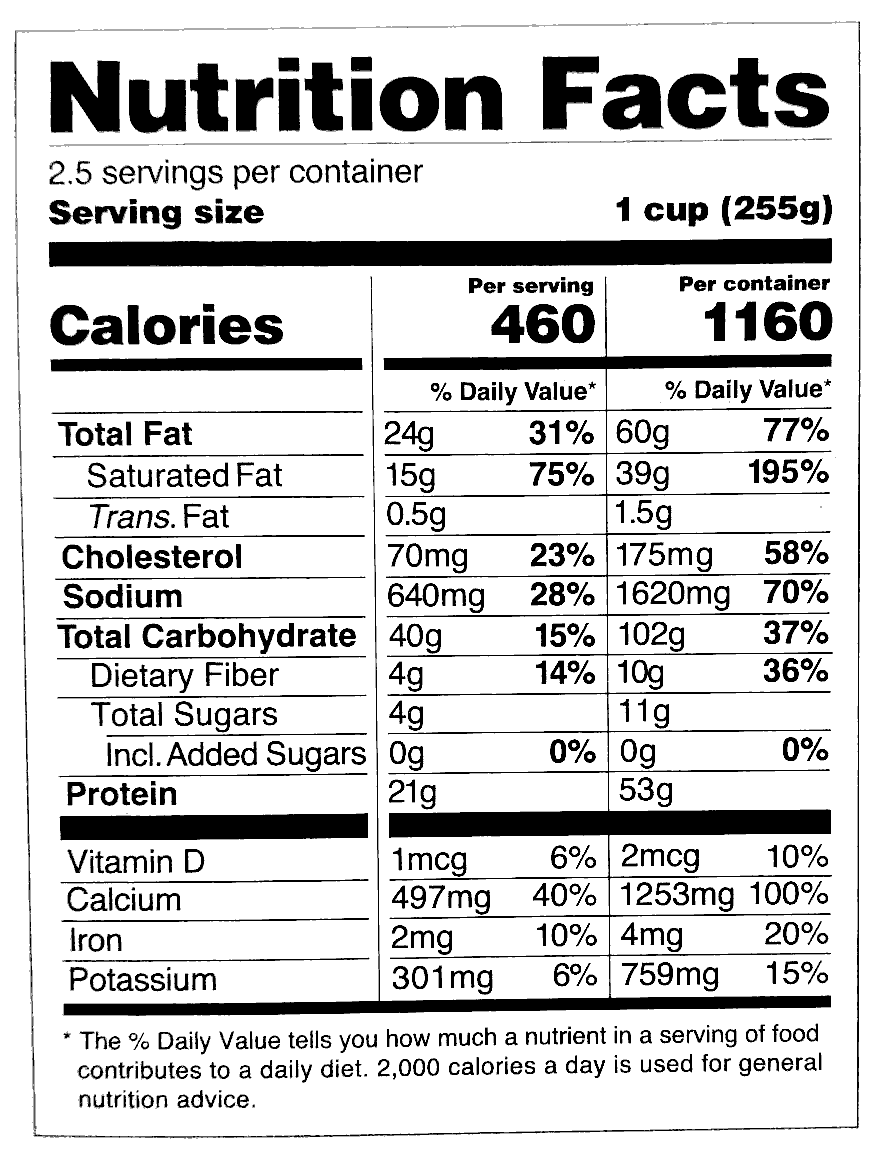
This frozen mac and cheese I got one time is labeled as having 2.5 255 gram servings in a box of 567 grams total, which doesn't make sense.
Sometimes, when looking at food labels, I wonder how many servings there actually are in a container or how precise that "640mg" of sodium actually is... or how many servings are actually in a full container.
One way to learn that is to find the FDA's Guidance for Industry: Food Labeling Guide and check "APPENDIX H: ROUNDING THE VALUES ACCORDING TO FDA ROUNDING RULES": "> 140 mg - express to nearest 10 mg increment". That way to learn is no fun, only took a couple minutes, and teaches you that the rounding depends on on the absolute amount. In any case, the actual sodium in our example is apparently between 635mg and 645mg.
So what's a more fun way to make an educated guess at an answer that'll turn out to be incorrect?
Reference Label
Here's the nutrition label that we'll be looking at:

Ways to Figure Significance
Following the significant figures rules, we would conclude that "640mg" of sodium per serving is between 635mg and 645mg. However, that's correct.
Following the significant figures rules, we would conclude that "70mg" of cholesterol is between 69.5mg and 70.5mg. However, that's incorrect. Our good old friend APPENDIX H has this to say about cholesterol: "> 5 mg - express to nearest 5 mg increment". You silly goose.
The good news is that if we assume that every value is rounded to the nearest $U$ (for uncertainty), then we know that the "per serving" value and the "per container" value will be multiples of $U$. That means the worst-case for $U$ is Greatest Common Divisor of the "per serving" value and the "per container" value. For example, Dietary fiber must be rounded to the nearest $gcd(4, 10) = 2$ grams.
How many servings per container?
Well... if we look at the data in the nutrition facts (and net weight), we have 2 ways to estimate the true range. The dietary fiber per serving is between 1.5g and 2.5g based on significant figures and between 1g and 3g based on GCD rounding. Also trans fats per serving are between 0.45g and 0.55g based on significant figures and between 0.25g and 0.75g based on the GCD rounding. I find it kind of interesting that each rounding method is correct (or closer to correct) for different measurements.
Taking all of the ranges/intervals of per container and per servings values and dividing them, we get the following chart:
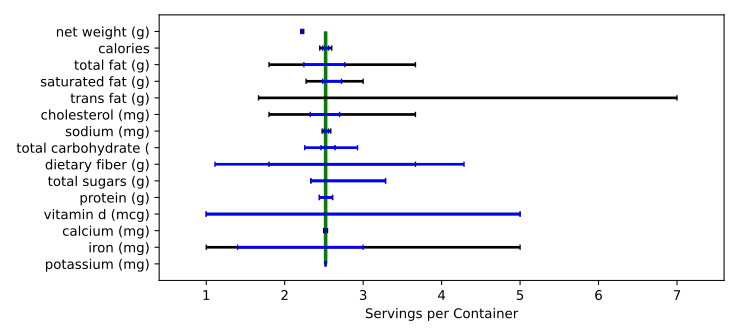
Black intervals are based on significant figures. Blue intervals are from the GCD rounding method. The green vertical line represents the intersection of all of those intervals, except for the interval based on the net weight in grams because it is such a big ol' lie.
There are between 2.515 and 2.528 servings per container based on everything except the net weight. Nice; Except the net weight.
Net Weight Lies
So what the heck is with net weight? Based on the net weight in grams, there are 2.204 to 2.243 servings per container. This might be explained by the conversion from ounces to grams giving a false sense of high precision. Unfortunately we don't have a number of ounces per serving so let's work around that.
# Since July 1st, 1959, 1 (avoirdupois) pound is exactly 0.45359237 kilograms
# See https://www.nist.gov/system/files/documents/2017/05/09/frn-59-5442-1959.pdf
kg_per_lb = 0.45359237
g_per_oz = 1000 * kg_per_lb / 16

plus_minus_half = ClosedInterval(-0.5, 0.5)
oz_per_serving = (255 + plus_minus_half) / g_per_oz + plus_minus_half
oz_per_container_conservative = (567 + plus_minus_half) / g_per_oz + plus_minus_half
oz_per_container = 20 + plus_minus_half
print("Ounces per serving =", oz_per_serving)
print("Ounces per container (conservative) =", oz_per_container_conservative)
print("Ounces per container =", oz_per_container)
print("Approximate servings per container (conservative) =", oz_per_container_conservative / oz_per_serving)
print("Approximate servings per container =", oz_per_container / oz_per_serving)
print()

"""Output:
Ounces per serving = [8.477223316168216, 9.512497278117795]
Ounces per container (conservative) = [19.482699444437305, 20.517973406386883]
Ounces per container = [19.5, 20.5]
Approximate servings per container (conservative) = [2.048116164958554, 2.4203648578248376]
Approximate servings per container = [2.049934883540739, 2.4182446581183368]
"""
Maybe net weight doesn't mean what I think it means?
Section 5.1 and 5.3 of the FDA's Guidance for Industry: Food Labeling Guide says "The net quantity of contents (net quantity statement) is the statement on the label which provides the amount of food in the container or package. It must be expressed in weight, measure or numeric count." and "Food labels printed must show the net contents in both metric (grams, kilograms, milliliters, liters) and U.S. Customary System (ounces, pounds, fluid ounces) terms."
Section L92 says "If a single unit weighs 50% or less of the RACC, the serving size will be the number of whole units closest to the RACC. For example, the RACC for hard candy is 15 g; therefore, 50% of the RACC is 7.5 g. For a bag of candy where the individual candies weigh 4 g (less than 7.5 g), the serving size would be '4 candies (16 g).'"
You might wondering what the RACC is. It's not a bird. RACC stands for Reference Amounts Customarily Consumed. The FDA's Reference Amounts Customarily Consumed: List of Products for Each Product Category: Guidance for Industry which I think consists solely of "Contains Nonbinding Recommendations" says the reference amount is "1 cup".
Conclusion
The "servings per container" and all the nutrition facts all agree with each other except for the serving size because the FDA gives "nonbinding recommendations" to round the serving size to the nearest "reference amount customarily consumed" for that particular type of product.
And that's why the frozen mac and cheese I got one time is labeled as having 2.5 255 gram servings in a box of 567 grams total.
Having the serving size and number of servings per container clearly conflict is kind of a silly thing.
Misc.
Did you know that Python 3 uses HALF_EVEN rounding?
COMMENTS
You can comment on this post by replying to infosec.exchange/@mikelmcdaniel/117630480265218666 on Mastodon.
Don't have a Mastodon account? JoinMastodon.org.